Let’s Kill Uncle is more than just a mid-’60s William Castle shlocker — here’s a look back at its literary inspiration!
It took me a while to discover the novel Let’s Kill Uncle by Rohan O’Grady (1963) after seeing the movie as a kid on late night TV. Sometimes a book leads you to the film adaptation. Sometimes it’s the other way around.
Once upon a time late night was a different landscape, and one affiliate where I lived back in the day would take back a night from network programming to run a film of their own.
Sometimes you just tuned in and checked what they had to offer. One of those times, the film title that popped up was Let’s Kill Uncle (1966) from the gimmick-master William Castle. He’d done things like The Tingler (1959) where select audience members received a shock from a specially wired theater seat. And he’d offered audiences the chance to give a thumb up or down for Mr. Sardonicus (1961).

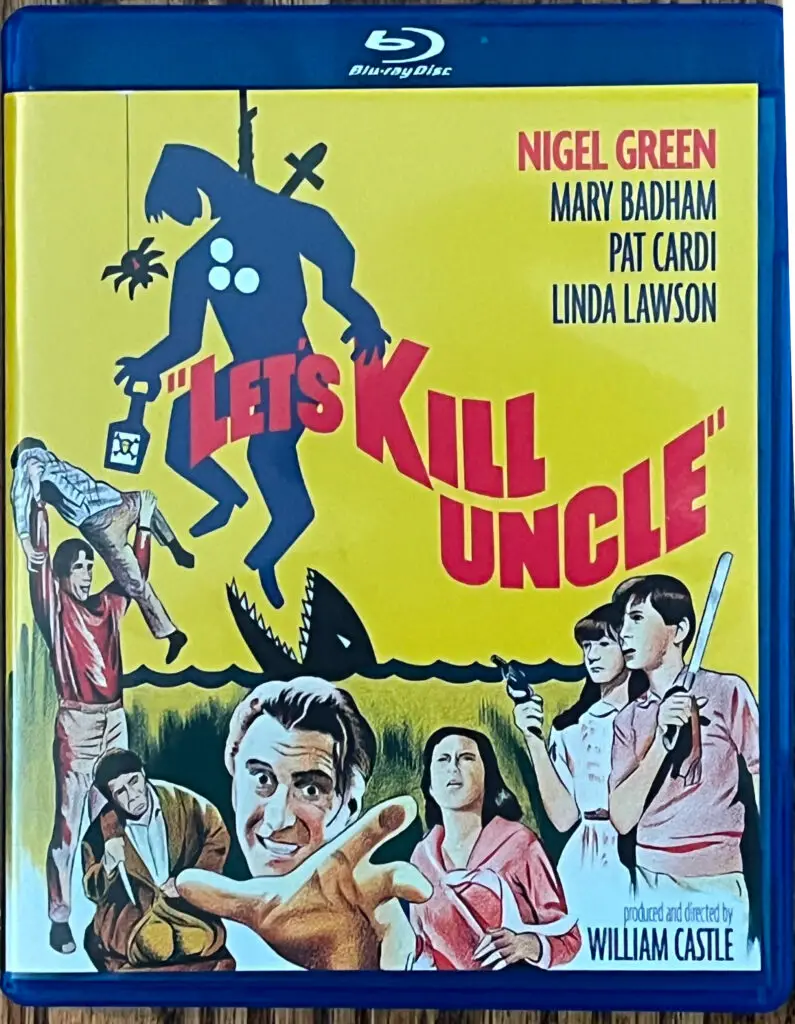
Let’s Kill Uncle offered him a step up from his sideshow approach and his black-and-white chillers. He probably had a few more bucks in the budget. When I was a kid, it was a glorious romp.
It featured Barnaby Harrison (Pat Cardi), an incorrigible kid who finds himself pitted against his ex-commando uncle (Nigel Green). Uncle launches a kill-or-be killed game, and he has a shark pool and other techniques of death on hand.
All of this was transpiring on an island, and Barnaby was forced to work with the island’s other resident his age, Chrissie, even though they’ve been adversarial at times. Mary Badham who’d played Scout in To Kill A Mockingbird and a central character in a Twilight Zone episode played Chrissie, though I didn’t connect the dots on first viewing.
The film’s a darkly comic excursion with Castle touches including a bloody opening cameo. Poisonings and back-and-forth attempts at death fail. There’s a genuinely eerie moment when the shark fin first knifes through the grimy water of the shark pool. Later you have to ask: “How’s the shark surviving in a pool that size? Does Uncle periodically toss in a side of beef?” In the moment, it’s effective, though.
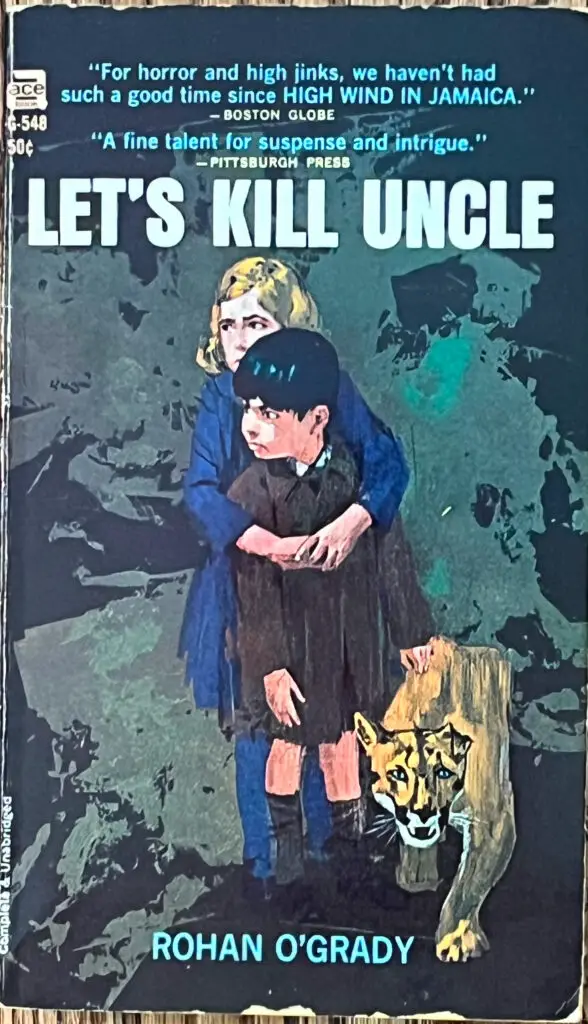
I didn’t realize until many years later there was a novel. I picked up a used 1963 Ace edition, a slim small volume with a line drawing at the book’s opening. It aligned nostalgically with some Edgar Rice Burroughs Ace editions I’d inherited from a neighbor, so I was glad to nab that iteration.
The book features a whimsical tone, but it’s a bit more serious than the camp or almost-camp of the film. It’s also much more detailed, and it’s a rich reading experience.
O’Grady was Canadian author June Skinner writing pseudonymously. The island is Canadian too in the book, and it’s much more populated. It includes stores, a World War II monument, a bit of society and a cougar named One-Ear.
One-Ear is a significant and actually charming character and plays a quite different role than the shark. Having hopped a log boat for the trip to the island, he’s wise enough to be wary of humans and aware he probably shouldn’t snack on even incorrigible kids.
Eventually the kids befriend him, and generate only mild annoyance when they get too friendly. He lightly cuffs Barnaby with a huge paw to end one bit of behavior.
The film’s sort of generic and clean cut police detective who’s somehow serving as a guardian for Barnaby in the novel is a Canadian Mounty with survivor’s guilt as the island’s only World War II participant who made it home alive. He’s thus more textured and complex as he deals with Barnaby and Christie as they vandalize a few spots on the island and paint designs on a local bull.
Much is established before the struggle with Uncle gets underway. He’s sinister and dangerous but not as over-the-top as Green’s beret-wearing killer in the film version.
The story’s still suspenseful with the children, realizing the danger Uncle poses, working to secure a firearm and plotting other measures to survive.
It’s toward the novel’s latter portion that it comes to earn its place as a work of horror. The film takes a little more upbeat tone for that.
I’m glad stumbled on the movie and that it led me to the book. It’s a unique little journey perhaps comparable a bit to Shirley Jackson.
Happily the film’s available from Kino Lorber with fun extras including an interview with Cardi, and the book’s out in a newer edition as well.